A SHORT PADDLE THROUGH THINK TANKS
". . . phony institutes where ideologue-propagandists pose as academics ... into which money gushes like blood from opened arteries to support meaningless advertising's suffocation of genuine debate". (John Chuckman)
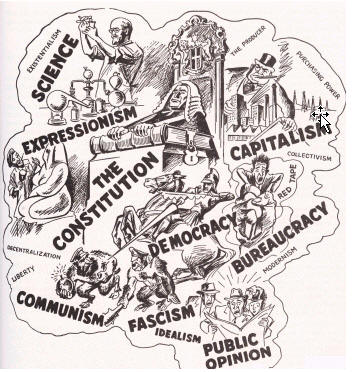 Newspapers are interesting places. As well as giving us crosswords and weather reports, they provide a picture of what we’re supposed to believe at any given time. In any newspaper there’s a possibility that the column or opinion piece you’re reading will have come from a neo-conservative think tank. Think tanks are organisations which seek to mould public opinion and exercise political influence. Using networks like clubs, the media, universities and corporations, they focus pressure on target bodies. They work at developing intimate relationships with government, business and academic communities.
Neo-conservative think tanks support a philosophy based on the primacy of individual rights over the collective good. From this is formed a worldview which promotes the free market, privatisation and competition and opposes welfare, public infrastructure and environmental and social regulation. Formerly called economic liberalism, it is now known as economic rationalism. It’s about small government - less intervention in the economy and less redistribution of wealth. The principle is that markets and money can do anything better than governments, bureaucracy or the law. At the heart of it is the idea of the self-made man, beholden to none. Needless to say, Aboriginal people, the unemployed, unionists, feminists and environmentalists don’t constitute a major part of the membership of these organisations.
Think tanks abound in Britain and the US.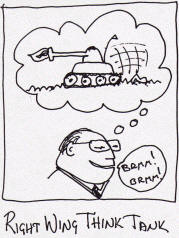 Margaret Thatcher’s manifesto was written by her think tank, the Centre for Policy Studies. Many of the ideas put forward then are now mainstream policy, like union emasculation and free trade. Neo-conservative think tanks can be traced to the Austrian economist Frederich von Hayek. After World War Two, the interventionist theories of John Maynard Keynes gained ascendancy. Those ideas were strenuously opposed by von Hayek, who believed that Keynes’ collectivist theories of demand management and full employment took "the naive down the dark road to totalitarianism." Von Hayek established the Mont Pelerin Society, dedicated to map out a counter-strategy against what they saw as the creeping socialism of post-war economies. The Society spawned think tanks in many countries, including the CIS in Australia. In 1978, CIS director Greg Lindsay went to his first Mont Pelerin meeting in Hong Kong where he was introduced to Professor Milton Friedman. Ayn Rand is another inspiration for the neo-conservatives.
In Australia, think tanks have proliferated over the last twenty years. Out of about 83, only five are considered to be "wet" tanks (that is, politically left). With a collective budget of $130 million, they employ 1,600 people, publish 900 reports and discussion papers, and hold almost 600 conferences and symposia each year. Corporate contribution and personal wealth are the biggest source of funding. All of the larger well-funded think tanks are in an excellent position to influence public opinion. Major neo-conservative Australian think tanks include:
Centre for Independent Studies
: Head: Greg Lindsay. Espouses free-market economics and individual choice, Socially conservative policies on welfare, poverty and family. CIS articles feature in The Australian, The Australian Financial Review, The Sydney Morning Herald, The Age, The Daily Telegraph, The Canberra Times, The West Australian, ABC Radio, SBS, 2GB, 2UE, 2SM, 3A, Lateline, 7:30 Report, Insight, Today and Today Tonight. Their targets include the unemployed, sole parents and foreign aid. They oppose ‘neo-socialism’, claiming over-regulation curbs property rights. They advocate lower taxes, a six-month limit on unemployment benefits and more policing. They argued for deregulation of financial markets and foreign investment before the Hawke government reforms. Budget $1.7 m. Representatives include Peter Saunders, Helen Hughes, Andrew Horton and Wolfgang Kasper.
The Lavoisier Group: Secretary: Ray Evans. Comprises former executives from the electricity, mining, engineering and construction industries including Hugh Morgan, Hal Clough, peter Walsh and Arvi Parbo. The focus is on discrediting the greenhouse effect. The group believes the Kyoto protocol presents us with "the most serious challenge to our sovereignty since the Japanese fleet entered the Coral Sea on May 3, 1942." Sample titles: ‘Carbon Blackmail Doesn't Lead to Greener Future’,by Hugh Morgan and ‘Goodbye to Life as We Like it When the Greens Get in For Their Chop’,by Peter Walsh. Most challenges to global warming in Australia, can be traced either to the IPA or the Lavoisier Group.
Sydney Institute
: Head: Gerard Henderson. Gerard Henderson writes opinion pieces in the Sydney Morning Herald – there’s no mention of the Sydney Institute. In recent articles he’s suggested that the war on Iraq was fully justified, that the pig-headed ABC deserves funding cuts, that Dr Hanah Ashrawi shouldn’t be awarded the Sydney peace prize, and that government programs to help the poor are very costly for wealthy people.
Institute of Public Affairs
: Head: Mike Nahan. Formed to promote the interests of free enterprise, but has recently expanded its interests to social issues. The IPA pamphlets – Facts - have a reputed print-run of 58,000, sent to 12,000 schools, 475 companies and 2,000 individuals. Their features can be read in the West Australian ,the Adelaide Advertiser, the Australian, the Australian Financial review, the Herald Sun and the Courier Mail. The IPA’s targets include environmentalists, Aboriginal rights, the ABC, unions, non-government organisations and ‘middle-class activists’. Not politically aligned but linked to Liberal Party figures. Budget $800,000. Contributions come from Western Mining, BHP Billiton, Caltex, Esso, Shell, Gunns, Monsanto, Clough Engineering, Philip Morris and British American Tobacco, among many others. Executive officer Mike Nahan’s this year told the Victorian Farmers Federation: "Depite being fundamentally at odds with the broader interests of society, the deep greens have gained significant influence and are doing great damage to the environment, to society and to civil society." Media contributors include Mike Nahan, Alan Moran, Gary Johns.
The IPA is particularly successful at getting their views in print. As their website says, ‘In the last year alone we notched up over 200 media appearances or mentions---a very good strike rate for an organization of our size and a clear indication that we are not only thinkers, but doers as well.’ Let’s have a brief look at a few of those media appearances.
‘Time for Tax Cuts’, Mike Nahan. Herald Sun. Supportive of raising the threshold for top marginal tax rate to $75,000. Corporate and personal tax is far too high.
‘The Great Land Grab,’ Mike Nahan. The Australian. Hits out at vegetation clearing laws.
‘Charities That Are Really Political Lobbyists Must be Exposed,’ Mike Nahan. The Age. Supports federal government’s draft charities bill to disqualify ‘law-breakers and trespassers’ like Greenpeace from having gift-recipient tax status.
‘Green Power Riddled By Perilous Politics And Specious Economics’, Alan Moran. The Age. ‘Wind power has its vested interests. Traders seeking to create a market for greenhouse credits and windmill developers have joined forces with a claque of green activists who would prefer everyone used a lot less energy anyway.’
‘Green Truth Just a Load of Hot Air’, Alan Moran. Courier Mail. This year the IPA devoted much time to talking up Danish statistician Bjorn Lomborg, author of ‘The Skeptical Environmentalist.’ Brought to Australia by Liberal MP Ian McFarlane, Lomborg is the hero of the anti-environment regulation lobby. According to Alan Moran, Lomborg’s book shocked the environmental movement. ‘Lomborg accepts that global warming will occur, but does not see it as catastrophic . . . But in any event, with increased wealth comes a capacity to avoid the consequences of hurricanes, heatwaves and cold snaps. And, as is also clear, increases in wealth are jeopardised by measures to prevent increases in greenhouse gases. We already can see this in Australia, where the Federal Government has said we must spend $380 million in increased electricity bills for renewable energy. In addition, Australian governments are pouring subsidies into windmill power and other renewables.’
Many people who read these columns are unaware that they are being fed think tank propaganda. Check out the by-line of the opinion piece you’re reading. Check the think tank websites for details of their outputs. In the next newsletter we’ll look at US think tanks. Meanwhile, maybe stick to the crossword.
-Clara